
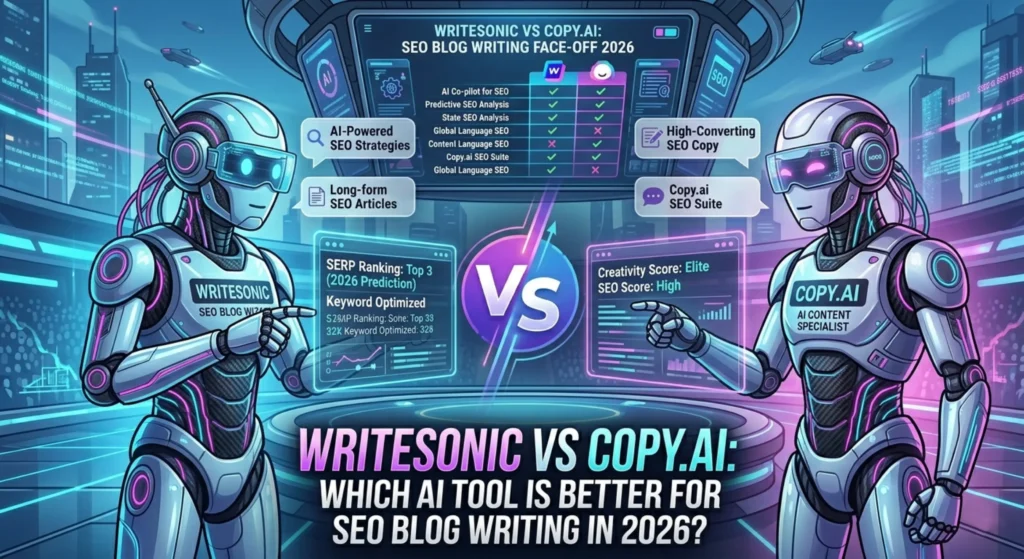
Writesonic vs Copy.ai: Which AI Tool is Better for SEO Blog Writing in 2026?
Affiliate Disclosure: This post contains affiliate links. If you click and make a purchase, SoftAIHub.com may earn a small commission at no extra cost to you. We only recommend software we have tested. Read our full Affiliate Disclosure here.
Introduction: The Real Struggle Behind “AI-Written SEO Blogs”
Choosing between Writesonic vs Copy.ai for SEO has become a critical decision for every digital creator in 2026. If you’ve tried using AI tools to write SEO blog posts, you probably know the frustration of generating content that sounds impressive but simply doesn’t rank.
Some tools produce “fluffy” text, while others help you write faster—but you still spend hours fixing structure, optimizing keywords, and adding human clarity.
In 2026, AI writing tools are no longer just “nice-to-have.” For bloggers, affiliate marketers, and SaaS site owners, they are productivity engines. But choosing the right one matters more than ever.
Two names dominate most comparison conversations: Writesonic and Copy.ai.
Both promise better content, faster workflows, and improved rankings. But when the goal is SEO blog writing specifically, the difference becomes more noticeable.
So which tool actually helps you write content that ranks, converts, and builds topical authority?
Quick preview verdict: Writesonic generally feels more SEO-workflow focused, while Copy.ai shines in ideation and short-form automation. Let’s break this down properly.
✓ Instant Access • No Risk
Quick Verdict: Writesonic vs Copy.ai for SEO (2026 Rankings)
Writesonic
- Best For: SEO blog writing, affiliate content, long-form optimization
- Starting Price: ~$20/month
- Free Trial: Yes
- Pros Snapshot: Built-in SEO flow, structured output, blog-focused tools
- Our Rating: 4.5 / 5
Copy.ai
- Best For: Marketing copy, idea generation, short-form content
- Starting Price: ~$36/month
- Free Trial: Yes
- Pros Snapshot: Fast workflow, templates, brainstorming strength
- Our Rating: 4.2 / 5
Micro-conclusion: If SEO blogging is your core growth channel, Writesonic tends to feel more purpose-built.
What is Writesonic?
Writesonic is an AI content platform designed to help users generate marketing content, long-form blog posts, landing pages, and SEO-driven articles.
Unlike basic AI writers that focus only on text generation, it positions itself as a content workflow assistant.
Real-World Usage Scenarios
- Affiliate blogger creating comparison posts
- SaaS founder publishing educational SEO guides
- Agency building topic clusters for clients
- Beginner launching niche authority sites
In practice, many users rely on Writesonic for:
- keyword-aligned blog drafting
- structured outlines
- AI-assisted optimization suggestions
It feels less like a random text generator — and more like a guided writing system.
What is Copy.ai?
Copy.ai began as a marketing copy automation tool.
Its strength lies in speed, ideation, and short-form creative output.
From product descriptions to social captions and email hooks, it helps teams move quickly from idea to draft.
Real-World Usage Scenarios
- Social media marketers producing high-volume content
- startups testing messaging variations
- bloggers brainstorming blog topics
- agencies creating ad copy
While Copy.ai has expanded into long-form workflows, its core DNA still leans toward creative automation rather than SEO depth.
Writesonic vs Copy.ai: A Deep Dive into Key SEO Features
Let’s look at the most impactful features that matter for SEO blog writers.
1. Long-Form Blog Generation
Writesonic offers structured blog workflows that guide users from keyword to outline to full article.
Practical Benefit:
You spend less time reorganizing content.
Mini Use Case:
An affiliate blogger writing “best AI tools” lists can generate section-ready drafts.
Who Should Use It:
SEO bloggers and niche site builders.
Copy.ai can generate long content too, but often requires more manual structuring afterward.
2. SEO Workflow Integration
Writesonic emphasizes SEO alignment — including heading suggestions and keyword placement prompts.
Benefit:
Content feels closer to publish-ready.
Use Case:
A marketer writing pillar content can maintain logical topic flow.
Copy.ai focuses more on content creativity than search structure.
3. Content Ideation Engine
Copy.ai excels here.
Benefit:
Rapid brainstorming.
Use Case:
Generating 20 blog angles in minutes.
Best For:
Content strategists planning calendars.
Writesonic also offers ideas — but Copy.ai’s template ecosystem is broader.
4. Content Repurposing
Both tools allow repurposing.
Writesonic can turn blogs into summaries or intros.
Copy.ai can generate multiple tone variations.
Benefit:
Faster omnichannel publishing.
5. Workflow Automation
Copy.ai’s newer automation features help build marketing sequences.
Use Case:
Creating newsletter + landing page + ad copy flow.
Writesonic focuses automation more on content generation pipelines.
6. Tone & Style Adaptability
Copy.ai produces more creative tone variations.
Writesonic focuses on clarity and structure.
Who Should Care:
Brand storytellers vs SEO publishers.
7. Speed vs Depth Balance
Copy.ai = faster ideation
Writesonic = deeper structured drafting
Micro-conclusion: One accelerates thinking. The other accelerates publishing.
Pricing & Plans Breakdown
Writesonic Pricing
Typical tiers include:
- Starter plan for individuals
- Creator plan for bloggers
- Business plans for teams
Value Perspective:
Affordable entry point makes it attractive for affiliate site owners.
Copy.ai Pricing
Plans are usually higher but include broader automation capabilities.
Value Perspective:
Better ROI for marketing teams managing multiple channels.
Value-for-Money Verdict
If your revenue depends on SEO traffic, Writesonic’s pricing often aligns better with ROI expectations.
If your workflow depends on creative testing and messaging scale, Copy.ai’s plans may justify their cost.
Once you’ve generated high-quality content with Writesonic, you’ll need a place to convert those readers into customers. We recommend checking out our Systeme.io Review 2026 to see how you can build automated sales funnels for your AI-generated content.
Pros and Cons
Writesonic Pros
- SEO-focused content workflows
- Affordable for beginners
- Structured blog output
- Useful for affiliate content
Writesonic Limitations
- Sometimes overly structured drafts
- creative tone options fewer
- occasional need for manual editing
Copy.ai Pros
- Powerful brainstorming capability
- excellent short-form copy generation
- automation workflows improving
- marketing-team friendly
Copy.ai Limitations
- long-form SEO alignment weaker
- pricing slightly higher
- blog formatting requires manual effort
Writesonic vs Copy.ai Comparison for SEO Blog Writing
Let’s simplify the decision.
Choose Writesonic If:
- you build niche SEO sites
- write affiliate comparison posts
- focus on Google rankings
- want structured article drafts
Choose Copy.ai If:
- you produce social content at scale
- need creative campaign ideas
- manage multiple brand voices
- test messaging frequently
Interestingly, many advanced bloggers use both.
They brainstorm with Copy.ai and publish with Writesonic.
Real Use Cases
Bloggers
Writesonic helps maintain consistency in long-form publishing.
Marketers
Copy.ai enables rapid experimentation.
Agencies
Combining both tools improves workflow flexibility.
Beginners
Writesonic reduces overwhelm with guided content flow.
Micro-conclusion: Your content business model decides your ideal tool.
Tips to Get Best Results
Tip 1: Always Start With Search Intent
AI tools cannot fix poor keyword targeting.
Tip 2: Edit for Human Flow
Even strong drafts need personal tone adjustments.
Tip 3: Build Topic Clusters
Use AI to create related posts quickly.
Tip 4: Use Tables and Comparisons
SEO readers prefer scannable content.
Tip 5: Track Rankings After Publishing
AI efficiency matters only if rankings improve.
Final Verdict: Which AI Tool Wins for SEO Blog Writing?
There isn’t a universal winner — but there is a contextual one.
If your primary goal is ranking blog content, building affiliate funnels, and scaling niche authority, Writesonic often feels more aligned with that mission.
Its structured workflows reduce friction between drafting and publishing. Over time, that consistency can translate into stronger topical authority and improved organic visibility.
Copy.ai remains a powerful companion tool — especially for idea generation and marketing experimentation. It thrives in environments where creativity and speed matter more than search architecture.
In 2026, smart content creators don’t always choose one. They build systems.
But if you must pick a single platform to support SEO blog writing momentum, Writesonic typically delivers the more focused experience.
The real advantage comes when AI tools stop being novelty assistants — and start becoming strategic publishing partners.
✓ Instant Access • No Risk
🚀 Wanna Master AI Writing for SEO?
Check out our exclusive deep-dives to scale your blog rankings with SoftAIHub:
🤖 [The Full Verdict]: Writesonic Review 2026: The Honest Truth
💰 [The Profit Blueprint]: How to Write SEO Blog Posts Using Writesonic
🏆 [The Top Picks]: Best AI Writing Tools for SEO in 2026
🆚 [The Ultimate Clash]: Writesonic vs Jasper: Best SEO AI in 2026?